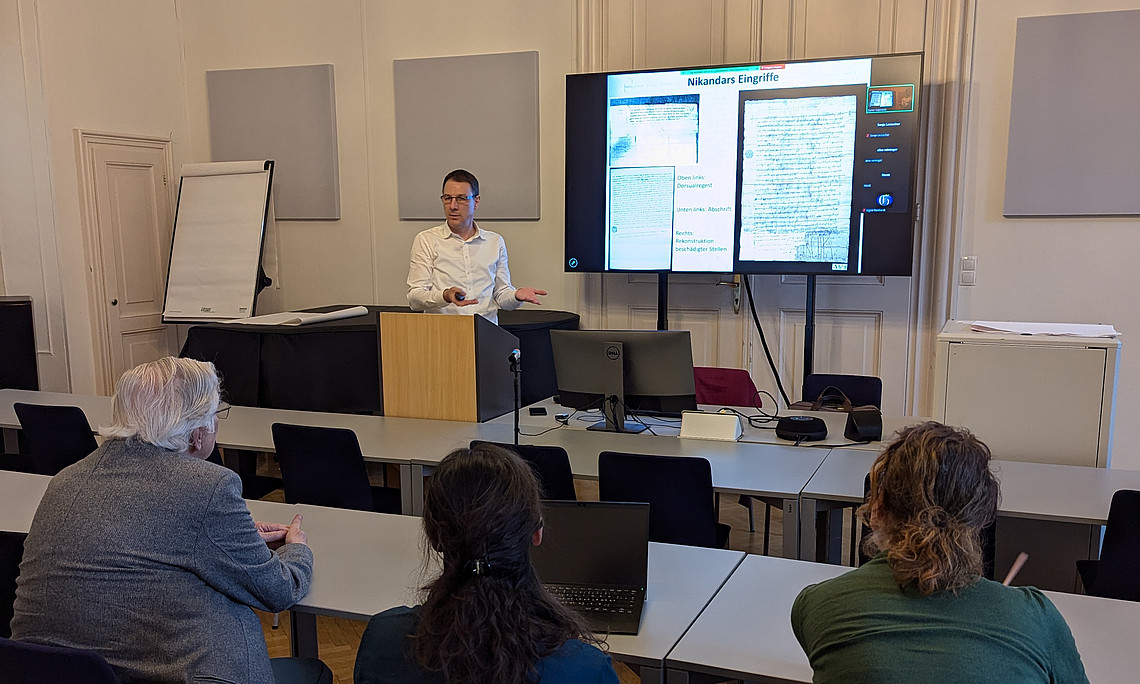




On 12 May, I hosted a blackout poetry workshop organized collaboratively with Mag. (FH) Verena Haidenberger as part of my course “Introduction to Literary Studies I.” The session invited my group of students to step outside the conventional analytical frame of the proseminar and engage with poetry as something they could actively make rather than only interpret. Blackout poetry, a form of found poetry in which an existing printed page is selectively obscured so that the remaining words form a new composition, has proved an ideal vehicle for this shift, since it asks students to treat language as raw material and to discover poetry already latent within a given text.
The workshop opened with an introduction to the method by Mag. (FH) Verena Haidenberger, situating blackout poetry within the broader traditions of found and erasure poetry and clarifying how meaning can be generated through subtraction as much as through addition. With this foundation in place, students set to work creating their own original pieces. What followed was a genuinely impressive display of inventiveness: working entirely from scratch, participants developed highly original ideas and arrived at strikingly varied results from comparable source material.
Beyond the individual pieces produced, the workshop achieved two broader pedagogical goals. First, it showed students one concrete way of creating poetry outside the seminar room, reframing literary study as a creative and hands-on activity rather than a purely receptive one. Second, it opened up space for students to consider how poetry remains relevant today, connecting a centuries-old art form to contemporary modes of making, remixing, and reusing existing material.
Overall, the blackout poetry workshop offered students a memorable and productive encounter with creative practice, and this was the fifth blackout poetry workshop Verena and I organized for my groups of students. The enthusiasm and originality on display suggest that integrating such hands-on sessions into the introductory curriculum meaningfully enriches students’ understanding of what literature is and what it can do. I am grateful to Mag. (FH) Verena Haidenberger for her collaboration in making the event a success and grateful to the cluster coordinators PD Dr. Ingeborg Zechner, MA, and PD Dr. Olaf Terpitz, MA, for making this event possible.